Agile instructional design is a method for building training in short, iterative cycles: releasing early, gathering feedback, and improving continuously, rather than completing every phase before learners see anything. Where ADDIE moves in sequence (Analysis, Design, Development, Implementation, Evaluation), the agile instructional design model runs those activities in parallel and repeats them, so courses stay current and reflect what learners actually need.
The approach comes from agile software development, where teams ship working software early and refine it based on real use rather than waiting for a perfect release. Applied to e-learning, agile learning design means a rough first module can go out in weeks, not months, and the full course improves with every round of learner feedback. That matters most when content changes fast. Product updates, regulatory changes, new processes: by the time a traditional ADDIE course ships, the material can already be wrong.
As Tommy Gruederich, CEO of Easygenerator, put it: “The expectation is everything instant, fast, personalized. Companies, L&D, everybody needs to correspond to that, to not be a dusty, outdated solution.”
Understanding agile instructional design
Agile instructional design is a flexible approach to creating training where content is built in small cycles, tested with real learners, and updated based on what the feedback shows, rather than locked into a fixed plan from day one.
Core principles of the agile learning design model include:
- Iterative development: training content is built in short cycles. Each cycle produces something learners can use, and each round of use produces something the team can improve.
- Continuous feedback: learners, subject-matter experts (SMEs), and stakeholders give input throughout development, not just at the end. Problems surface early, when they are cheap to fix.
- Learner-centric approach: design decisions are driven by how learners actually use and respond to the content, not by what looks complete on a project plan.
ADDIE vs. agile instructional design
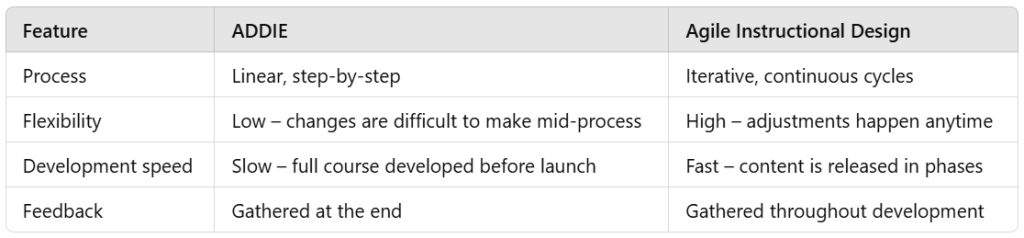
ADDIE asks you to finish each phase before starting the next: analysis done, then design, then development, then launch. Agile instructional design works differently. You build a small piece, test it with real learners, collect feedback, and improve it before moving on. Each release is a starting point, not a finished product. That thinking comes directly from agile software development, where teams ship working updates instead of waiting until everything is perfect.
Read more about why the ADDIE model is outdated for your L&D strategy.
The agile instructional design process
The agile instructional design process runs in overlapping loops rather than a straight line from analysis to delivery. Feedback shapes the next version of the content, which gets tested again, which generates more feedback. Here is how that plays out in practice:
1. Analysis and rapid prototyping
In rapid prototyping instructional design, you skip the months-long planning phase and build something learners can actually respond to. That might be a single five-minute module, a rough interactive draft, or a stripped-down version of the full course. The goal is to get something real in front of stakeholders and learners as quickly as possible, so feedback is based on actual content rather than a written spec nobody fully agrees on.
2. Testing and feedback
Learners and subject-matter experts review the prototype and say what works and what does not. Because the module is small, the feedback is specific rather than overwhelming. This is also the stage where adaptive learning design fits naturally: if your platform supports it, learner performance data from early testing can inform how the next version branches or adjusts to individual needs.
Tommy Gruederich, CEO of Easygenerator, puts it plainly: “The expectation is everything instant, fast, personalized, I would even say hyper-personalized.” That expectation applies to how L&D teams deliver content too. Sitting on a course for six months while it goes through review cycles is not a viable strategy when business needs change faster than content can ship.
3. Iteration and updates
Each round of feedback produces a concrete list of changes. Some are quick fixes: a confusing question rewritten, an outdated example swapped out. Others are more substantial, like restructuring a section that learners consistently skip. The agile elearning development cycle repeats until the training does what it needs to do, rather than stopping at a predetermined deadline.
4. Implementation and continuous improvement
Publishing the course is not the end of the agile instructional design method. It is closer to the middle. Once the course is live, usage data and learner feedback keep feeding the next update. When a product changes, when a process shifts, or when assessment results show a gap, the content gets updated rather than replaced wholesale. That is what makes agile learning design genuinely different from a traditional build: the course is a living document, not a one-time project with a sign-off date.
Who is involved?
Agile instructional design draws on the right people at every stage, not just the L&D team. A typical agile learning design team includes four groups:
- Instructional designers: guide the overall agile instructional design process, set the learning objectives, and make sure each iteration reflects sound learning principles rather than just stakeholder preferences.
- Subject-matter experts (SMEs): contribute the knowledge that makes content accurate and relevant. In an agile elearning development model, SMEs are involved throughout, not just at the brief stage, so the course reflects how the job actually works rather than how it looked when the project kicked off.
- Learners: test early prototypes and give feedback on what is clear, what is missing, and what does not match how they work. This is what separates the agile learning design model from traditional approaches. Rather than waiting until a course is finished to find out whether it lands, you find out during development, when changes are still cheap.
- Managers: connect learning outcomes to business goals and flag when priorities shift. In a fast-moving organisation, this matters. A manager who spots mid-project that the team’s biggest gap has changed can redirect the next sprint before the wrong content is finished and signed off.
Benefits of agile instructional design
- Faster course development: training can go live in weeks instead of months, because small working modules ship before the full course is finished.
- Continuous improvement: courses update after each sprint based on real learner feedback, so the material reflects how work actually happens rather than how it looked at the start of the project.
- Closer alignment with business needs: because stakeholders review each iteration, training stays tied to current priorities rather than drifting toward what the brief said six months ago.
Agile instructional design methods and models
The most widely used agile instructional design model is the Successive Approximation Model (SAM), developed by Michael Allen. SAM replaces the linear progression of traditional models with a rapid prototyping instructional design process: build a rough version, test it with real learners, collect feedback, and revise. Then repeat. Instead of waiting until a course is finished to find out whether it works, designers catch and fix problems at every stage. A first prototype might be nothing more than a storyboard or a handful of slides, enough to test the core idea before anyone invests time in polishing it.
How Employee-generated Learning fits in
Employee-generated Learning (EGL) removes the bottleneck that slows most traditional development cycles: the wait for L&D to do everything. Rather than relying solely on instructional designers, EGL gives subject-matter experts (SMEs) the tools to create and update content themselves. Knowledge moves from the person who has it to the people who need it, without queuing for a production team.
Talha Faridy, AI Product Lead at Easygenerator, puts it this way: “AI is helping reduce the barriers to sharing and consuming knowledge. In the past, without large language models, it was a monumental task for someone to create a learning. Why would I, as a subject-matter expert, wake up and decide to create e-learning and share knowledge? There are so many barriers. But AI makes it possible for me today to get a working e-learning module created within minutes, verify the output, and quickly share it with my peers.”
That dynamic matters most when content has a short shelf life. In a fast-moving tech company, for example, product updates happen faster than any central L&D team can track. Rather than waiting months for a course to be commissioned, scripted, reviewed, and published, product managers and engineers can build microlearning modules on new features the week they ship. The Employee-generated Learning model makes that possible, and the agile elearning development process gives it structure, so speed does not come at the cost of quality.
The role of rapid e-learning in agile instructional design
Rapid e-learning and agile instructional design are related but not the same thing. Rapid e-learning is a development approach that uses authoring tools to build and update courses quickly. Agile instructional design is the broader method that decides what gets built, in what order, and how feedback shapes the next version.
The two work well together. When an agile learning design model drives the process, rapid e-learning tools become the engine that keeps pace with it. Teams can publish a working module, gather learner feedback, and push an update in days rather than months. That combination keeps training relevant as business needs shift, rather than going stale between annual review cycles.
How rapid e-learning supports agility
Speed and iteration: authoring tools let teams build, test, and revise modules without waiting for a full production cycle. A compliance update that once took three months can go live in a week.
Flexibility: when a product changes or a regulation shifts, individual modules can be updated without rebuilding an entire course from scratch.
SME-driven content: subject-matter experts can contribute knowledge directly, without needing instructional design skills to do it. This is at the heart of what makes agile e-learning development practical for teams without large L&D departments.
Lower cost and faster turnaround: shorter development cycles reduce both the time and budget required to keep training current.
That said, rapid e-learning tools alone do not make a process agile. As Talha Faridy, AI Product Lead at Easygenerator, puts it: “AI is helping reduce the barriers to sharing and consuming knowledge, but it’s the iterative process that makes it beautiful. It shouldn’t be taken as a one-shot, silver-bullet generation, but rather something that you iterate with to get to the result you’re looking for.” The same principle applies to agile instructional design as a whole: the method is what creates the loop of build, test, and improve. The tools just make that loop faster.
Conclusion
Agile instructional design is a method for building training that improves continuously based on real learner feedback, rather than being fixed at launch and reviewed annually. It lets teams respond to business changes without restarting from scratch each time.
The agile instructional design model works best when it runs alongside the tools and culture that support it: rapid e-learning authoring for speed, Employee-generated Learning for scale, and subject-matter experts who are involved from the start rather than consulted at the end. Together, these make company-tailored training practical for teams of any size.
The shift is not just operational. It asks L&D teams to treat training as something that evolves with the organisation, and to treat learners as active contributors to that process, not just recipients of it.